
Turnover
Turnover is an accounting term that refers specifically to the total sales made by a business over a particular period. This amount, the turnover will appear on an income statement. Some people also call this "income” or "gross revenue”. Turnover differs from profit, which is a measure of earnings.
Why Is Business Turnover Important?
There are several key reasons why business turnover is important. It helps all businesses to:
- Understand their financial status: Turnover helps businesses understand how much they earn in a given period, and it can help organisations understand how they're performing.
- Forecast: By calculating turnover, businesses can better forecast future sales to understand how they might allocate costs and where they might earn the most.
- Identify improvement areas: When calculating turnover, companies can see where they might have a lower rate and identify where they might improve areas of operation or sales.
- Determine risk: In investing, turnover can help a company or individual determine the risk of investing in a particular company. Low turnover can entail a higher risk of investment because it can show a company passively manages its funds.
How Do You Calculate Business Turnover?
The mechanism to work out business turnover is fairly straightforward. All businesses need to keep accurate records for tax purposes. Doing so will make adding up your total sales a relatively fast process.
Who Is Turnover Tax for?
Micro businesses with an annual turnover of R 1 million or less. Regardless of whether you are a business so small or a much larger company that is well established, the following taxpayers may qualify if they fall into these criteria:
- Individuals (sole proprietors)
- Partnerships
- Close corporations
- Companies
- Co-operatives
Keep in mind that turnover gets measured over a particular period. For example, this period might be during a tax year from March 1 until the end of February.
Here’s a simple example:
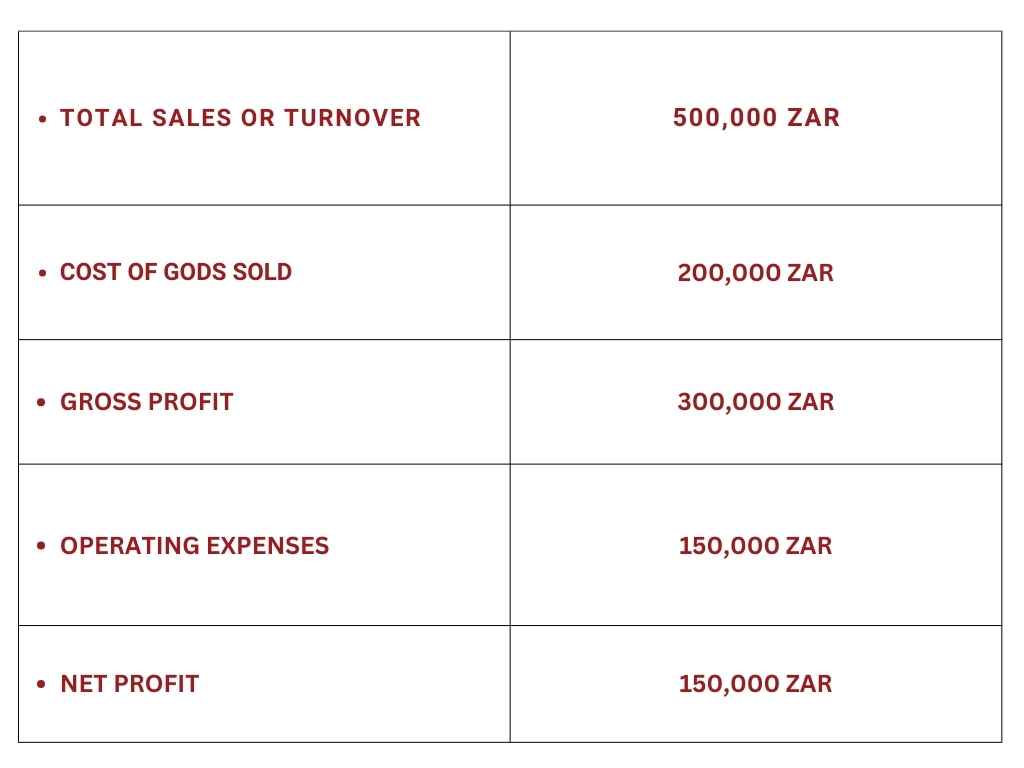
To calculate gross profit, deduct the cost of your sales from your turnover. To calculate net profit, work out your gross profit and take away all other expenses including your tax liabilities.
Types of Turnover
"Turnover” can take on a number of meanings other than the total figure of sales over a set period. For instance, you might use the term "turnover” to refer to the number of workers that leave a company within a specific period. Some people also call this the "employee churn rate”.
Common types of turnover ratios include:
- Accounts receivable turnover
- Inventory turnover
- Portfolio turnover
- Working capital turnover
Popular FAQs
To address any concerns you may have, we’ve collected some of the most frequently asked questions about turnover and turnover tax.
How Do I Register for Turnover Tax?
You first need to establish whether you qualify for turnover tax. If you are eligible to register, then you would need an appointment with SARS to process your registration.
How Do I Deregister Turnover Tax?
Deregistration can be voluntary or if your turnover exceeds R1 million then you would be forced to deregister.
The deregistration must be made in writing to the commissioner.
How Can I Pay Taxes?
You can pay by doing an EFT to SARS or at your local bank.
At Which Intervals Do I Pay Turnover Tax?
Turnover tax has two interim payments and then an annual return which is submitted during tax season which is usually open between July and January.
1st Interim payment = 6 months into the tax year - Based on 15% of total taxable turnover
2nd interim payment = 12 months into the tax year - Based on 65% of total taxable turnover (less the first 15% interim payment)
Annual payment = in tax season Based on 35% of total taxable turnover
What Records Should Be Kept?
The advantage of this tax system is the relief from the responsibility of record-keeping.
The following are records that must be kept:
- Records of all the amounts received.
- Records of all dividends declared.
- A list of each asset & liability with a cost price of R10000 or more.
What Are the Benefits of Turnover Tax?
Here are the top benefits of turnover tax for your business.
- Less record-keeping
- Lower tax rates
- Ability to get your business start-up off the ground.
- Reduced business compliance expenses.
Learn how to scrutinise your books and streamline your profit pipeline. Speak to a mentor today.
Suggested Experts Of Turnover

R625 / 30Mins
Founder
About
Victor is an Executive Consultant and Success Coach with a Master’s degree in Marketing from the International Institute of Marketing. As a certified NQF8 Marketer, he leverages his academic expertise and extensive experience to help individuals and businesses unlock their potential. Victor specializes in developing equity growth strategies and solving complex enterprise challenges with his team’s support.

No question is too big or too small. Our Experts are here to help you find answers.